
Concrete Calculator: Cubic Yards, Bags, Weight & Cost
Estimate exactly how much concrete your project needs, volume, cubic yards, bags, weight and cost, in seconds. Enter your dimensions below for an instant, accurate result for slabs, footings, columns and more, in imperial or metric.
Estimated concrete
- Cubic yards
- 0
- Cubic feet
- 0
- Cubic meters
- 0
- Liters
- 0
- Gallons (US)
- 0
- Weight
- 0
- Truck loads
- 0
- Estimated cost
- 0
Bags needed
- 40 lb
- 0
- 60 lb
- 0
- 80 lb
- 0
Estimates only. Add ~5–10% for waste. Bag yields: 40 lb ≈ 0.30, 60 lb ≈ 0.45, 80 lb ≈ 0.60 cu ft. Concrete ≈ 150 lb per cu ft.
How The Concrete Calculator works
- 1
Enter your dimensions
Type the length, width and thickness of your slab, footing or pad and choose your units, feet, inches or meters.
- 2
Get instant volume
See the result in cubic yards, cubic feet and cubic meters, plus weight, the moment you type, no page reloads.
- 3
Buy the right amount
We convert volume into the exact number of 40, 60 and 80 lb bags, truck loads and cost so you order without waste or shortfalls.
Concrete calculators by project type
Every project has its own dedicated calculator, pick the one that matches your pour.
Concrete bag yield & coverage
How much mixed concrete a standard bag yields, and how far a cubic yard goes at common slab depths.
| Bag size | Yield (cu ft) | Bags per cubic yard |
|---|---|---|
| 40 lb | 0.30 | 90 |
| 60 lb | 0.45 | 60 |
| 80 lb | 0.60 | 45 |
- 40 lb
- 60 lb
- 80 lb
How much does concrete cost?
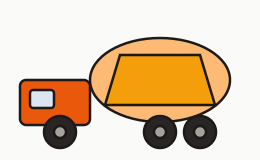
Ready-mix concrete typically costs about $125–$165 per cubic yard delivered in the US, and a full mixer truck carries roughly 10 cubic yards. Small orders may add a short-load fee. Enter a price per yard in the calculator above for an instant cost estimate.
Concrete mix ratio & strength
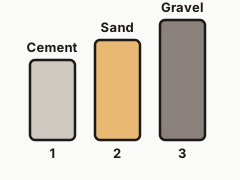
A common general-purpose mix is 1:2:3 (cement:sand:gravel) by volume, or 1:2:4 for footings, with a water-to-cement ratio near 0.45–0.55. Patios and paths are usually 3000 PSI, driveways and slabs 3500–4000 PSI, and structural pours 4000 PSI and up.
How to Calculate Concrete: The Complete Guide
To figure out how much concrete you need, multiply the length × width × thickness of the pour in feet, then divide by 27 to turn cubic feet into cubic yards. Ready-mix concrete is sold by the cubic yard, and bagged concrete is sold by weight (40, 60 or 80 lb), so the calculator above shows both. Always add 5–10% extra for uneven ground, spills and form bulge.
The concrete formula
Cubic yards = Length (ft) × Width (ft) × Thickness (in ÷ 12) ÷ 27
- Convert thickness from inches to feet by dividing by 12 (4 in = 0.333 ft, 6 in = 0.5 ft).
- One cubic yard is 27 cubic feet (3 ft × 3 ft × 3 ft).
- For round columns and Sonotubes use π × radius² × height instead of length × width.
Worked examples
- 10 × 10 ft patio, 4 in thick: 10 × 10 × 0.333 = 33.3 ft³ ÷ 27 = 1.23 cubic yards. With 10% extra, order about 1.36 yd³, or about 61 bags of 80 lb concrete.
- 20 ft strip footing, 16 in wide and 8 in deep: 20 × 1.333 × 0.667 = 17.8 ft³ ÷ 27 = 0.66 cubic yards.
- 12 in round column, 4 ft tall: 3.1416 × 0.5² × 4 = 3.14 ft³ = 0.12 cubic yards, about six 80 lb bags.
- 24 × 24 ft garage slab, 6 in thick: 24 × 24 × 0.5 = 288 ft³ ÷ 27 = 10.7 cubic yards, a little more than one full ready-mix truck.
How Many Bags of Concrete Do I Need?
A 60 lb bag of premixed concrete makes about 0.45 cubic feet and an 80 lb bag about 0.60 cubic feet. That means one cubic yard takes roughly 60 bags of 60 lb or 45 bags of 80 lb. The table shows common slab sizes (no waste added):
| Slab size | Thickness | Cubic yards | 60 lb bags | 80 lb bags |
|---|---|---|---|---|
| 4 × 4 ft | 4" | 0.20 | 12 | 9 |
| 10 × 10 ft | 4" | 1.23 | 75 | 56 |
| 12 × 12 ft | 4" | 1.78 | 107 | 80 |
| 10 × 20 ft | 4" | 2.47 | 149 | 112 |
| 12 × 24 ft | 4" | 3.56 | 214 | 160 |
| 20 × 20 ft | 4" | 4.94 | 297 | 223 |
| 24 × 24 ft | 4" | 7.11 | 427 | 320 |
| 10 × 10 ft | 6" | 1.85 | 112 | 84 |
| 20 × 20 ft | 6" | 7.41 | 445 | 334 |
| 24 × 24 ft | 6" | 10.67 | 640 | 480 |
Above about one cubic yard, ready-mix delivered by truck is usually cheaper and faster than mixing dozens of bags by hand, and it gives a more consistent slab.
How Thick Should a Concrete Slab Be?
| Project | Typical thickness | Common strength |
|---|---|---|
| Sidewalk, walkway | 4 in | 2,500–3,000 PSI |
| Patio, shed floor | 4 in | 3,000 PSI |
| Driveway (cars) | 4–5 in | 3,500–4,000 PSI |
| Garage floor | 4–6 in | 3,500–4,000 PSI |
| RV pad, heavy trucks | 6–8 in | 4,000 PSI |
| Footings | 8–12 in deep | 3,000–4,000 PSI |
Local building codes and soil conditions always come first. A well-compacted gravel base of 4–6 inches under the slab matters as much as the thickness itself.
How Much Does Concrete Weigh?
Normal-weight concrete weighs about 150 lb per cubic foot, which is about 4,050 lb (just over 2 tons) per cubic yard. A 4 in slab weighs roughly 50 lb per square foot and a 6 in slab about 75 lb per square foot. Use the concrete weight calculator for a full chart by cubic foot, yard and meter.
Ready-Mix vs. Bagged Concrete
- Bagged concrete is best for small jobs under about 1 cubic yard: fence posts, steps, small pads and repairs.
- Ready-mix is best for slabs, driveways and footings over 1 cubic yard. A standard mixer truck carries up to about 10 cubic yards; ordering less than a full load often adds a short-load fee.
- Ready-mix is ordered by strength (PSI) and slump. 3,000 PSI suits most residential flatwork; driveways and garages usually get 3,500–4,000 PSI.
Concrete for Posts, Columns and Sonotubes
Round holes and tube forms use the cylinder formula: π × (diameter ÷ 2)² × depth, with all measurements in feet. The table assumes an empty hole; a 4 × 4 post takes up a little of the volume, so the numbers already include a small safety margin.
| Hole or tube size | Cubic feet | 60 lb bags | 80 lb bags |
|---|---|---|---|
| 6 in × 24 in deep | 0.39 | 1 | 1 |
| 8 in × 24 in deep | 0.70 | 2 | 2 |
| 10 in × 36 in deep | 1.64 | 4 | 3 |
| 12 in × 36 in deep | 2.36 | 6 | 4 |
| 12 in × 48 in deep | 3.14 | 7 | 6 |
For deck footings and piers, the Sonotube calculator lists concrete per foot for every tube size from 6 to 36 inches, and the fence post calculator subtracts the post for you.
Concrete Steps, Curbs and Walls
Steps are calculated one riser at a time: each step is a box as wide as the stair, as deep as the run and as tall as all the risers below it. For example, four 7 in risers with 11 in treads and a 48 in width need about 0.8 cubic yards before the landing. Curbs combine the curb and gutter cross-sections, and block walls are calculated from the wall area and the size of the block cells. Use the dedicated steps, curb and block wall calculators for those shapes.
Concrete Mix Ratio for Mixing Your Own
If you mix from scratch instead of using premixed bags, a 1 : 2 : 3 ratio (cement : sand : gravel by volume) with about half a part water gives roughly 3,000 PSI concrete, which suits most slabs, steps and footings. Use 1 : 2 : 4 for mass footings and 1 : 1.5 : 3 when you need extra strength. One cubic yard of 1 : 2 : 3 concrete needs about seven 94 lb bags of Portland cement. The mix calculator works out cement, sand, gravel and water for any volume.
How Long Does Concrete Take to Cure?
- 24–48 hours: firm enough to walk on and remove forms.
- 7 days: about 70% of its design strength; light vehicles can usually drive on a driveway.
- 28 days: full design strength; safe for heavy loads.
Keep fresh concrete moist for the first week (wet curing, curing compound or plastic sheeting) and protect it from frost. Concrete that dries too fast loses strength and cracks.
Common Mistakes That Waste Concrete
- Forgetting to convert inches to feet for thickness, which makes the result 12 times too big.
- Dividing by 9 instead of 27 (9 converts square feet to square yards, not cubic feet to cubic yards).
- Ordering the exact volume. Every pour needs a little extra; running short costs more than a few leftover bags.
- Adding extra water to make concrete easier to place. It noticeably reduces strength and increases cracking.
Tips to Order the Right Amount
- Measure in several places. Ground is rarely level; use the average depth, not the shallowest spot.
- Add 5–10% waste for flat slabs and up to 15% for footings dug in soft soil.
- Split odd shapes into rectangles, circles and triangles, calculate each and add them together.
- Round up to the next quarter yard when ordering ready-mix. Running short mid-pour leaves a cold joint.
- Check access for the truck. If it cannot reach the forms, budget for a pump or wheelbarrows.
All concrete calculators
Pick the calculator that matches your project, each one asks for the right inputs and gives the answer you need.
- Concrete Slab Calculator
- Cinder Block & Wall Calculator
- Concrete Footing & Foundation Calculator
- Concrete Cylinder, Column & Post Calculator
- Concrete Pad Calculator
- Concrete Steps & Stairs Calculator
- Concrete Floor Calculator
- Concrete Driveway Calculator
- Concrete Patio & Sidewalk Calculator
- Concrete Curb & Gutter Calculator
- Concrete Beam Calculator
- Concrete Fence Post & Hole Calculator
- Concrete Pool Deck Calculator
- Concrete Yardage Calculator
- Concrete Bag Calculator
- Concrete Calculator by Square Footage
- Ready-Mix (RMC) Calculator
- Sonotube Calculator
- Cement Calculator
- Concrete Mix Ratio Calculator
- Gravel Calculator
- Rebar & Reinforcement Calculator
- Concrete Strength / PSI Calculator
- Mortar Calculator
- Concrete Cost Calculator
- Concrete Delivery & Truck Calculator
- Concrete Weight Calculator
- Calculadora de Concreto
Frequently asked questions
How much concrete do I need?
Multiply length × width × thickness (all in feet) to get cubic feet, then divide by 27 for cubic yards. The calculator above does this instantly, just enter your slab or footing dimensions.
How do I calculate concrete?
Concrete is measured by volume: length × width × depth. Convert inches to feet (÷12), multiply the three dimensions, then divide by 27 to get cubic yards. Enter your numbers above for an exact figure.
How much is a yard of concrete?
A cubic yard of ready-mix concrete typically costs about $125–$165 delivered in the US, depending on PSI, region and load size. Short loads may add a fee.
How many yards of concrete are in a truck?
A standard mixer truck holds about 10 cubic yards when full, though many deliver 8–11 yards. Partial loads are common but can carry a short-load charge.
How many bags of concrete are in a yard?
It takes about 45 × 80 lb bags, 60 × 60 lb bags, or 90 × 40 lb bags to make one cubic yard of concrete. The bag calculator gives the exact count for your project.
How much does a yard of concrete weigh?
One cubic yard of concrete weighs roughly 3,600–4,050 lb (about 1.8–2 tons). Standard concrete weighs about 150 lb per cubic foot.
How much does concrete cost per square foot?
A basic 4-inch poured slab typically runs $4–$8 per square foot, and more with reinforcement, decorative finishing or a thicker pour.
How many bags of concrete do I need?
Divide the total volume in cubic feet by the bag yield: an 80 lb bag ≈ 0.60 cu ft, a 60 lb bag ≈ 0.45 cu ft, a 40 lb bag ≈ 0.30 cu ft. The calculator above handles this automatically.
How much is a bag of concrete?
An 80 lb bag of ready-mix usually costs about $5–$8, and a pallet (42–56 bags) runs roughly $250–$400 depending on brand and retailer.
How many cubic feet are in a bag of concrete?
An 80 lb bag yields about 0.60 cu ft, a 60 lb bag about 0.45 cu ft, and a 40 lb bag about 0.30 cu ft of mixed concrete.
How many square feet does a yard of concrete cover?
At 4 inches thick, one cubic yard covers about 81 sq ft; at 5 inches about 65 sq ft; and at 6 inches about 54 sq ft.
How thick should a concrete slab be?
Most residential slabs and patios are poured 4 inches thick. Driveways and load-bearing areas are typically 5–6 inches, often with rebar or wire mesh.